
Gall Bladder Surgery
What is laparoscopic cholecystectomy?
Laparoscopic cholecystectomy or keyhole gallbladder surgery is currently the "gold standard" treatment for gallstones. It is a minimally invasive surgery performed to remove the entire gallbladder along with the gallstones. This is the only effective treatment for gallstones as the removal of only the gallstones can lead to recurrence in the following months or years.
Mr Michael Bickford is one of the pioneers in laparoscopic gallbladder removal in Australia, and has performed over 7000 operations.
What is the gallbladder? How do gallstones form?
The gallbladder is a pear-shaped organ present below the liver. It collects bile from the liver, and concentrates and transports it to the small intestine for the digestion of fats.
An imbalance in the contents of bile can lead to the formation of a gallstone or many gallstones. There can be two types of gallstones:
Cholesterol stones: Most common type, caused by excess cholesterol in bile
Pigment stones: Smaller stones composed of excess bilirubin, a pigment found in bile
What are the causes of gallstones?
The risks of developing gallstones may include:
- Being female although men get gallstones too
- Being obese or overweight
- Aged 40 years or more
- Suffering from certain liver diseases that affect the flow of bile
- Suffering from certain disorders that affect the intestine such as irritable bowel syndrome (IBS) or Crohn's disease
- Having a family history of gallstones
- Having recently lost weight through diet or weight-loss surgery
What are the signs and symptoms of gallstones?
These stones can get trapped in the ducts that carry bile to the intestine and lead to gallstone disease or cholelithiasis, which is characterised by severe abdominal pain, inflammation of the organ with or without jaundice.
How are gallstones diagnosed?
Gallstones are commonly diagnosed through imaging studies. Your doctor may order an ultrasound, MRI scan, CT scan or cholangiography (a dye injected into the bile ducts is tracked using X-ray imaging).
What are the consequences of not treating gallstones?
Certain small gallstones that do not cause symptoms do not require treatment. However, left untreated, gallstones can be fatal. They can cause inflammation in the bile ducts, gallbladder, liver or pancreas. This can in turn lead to infection, obstructive jaundice and even cancer.
What treatment choices are available for gallstones?
Key-hole surgery: Laparoscopic cholecystectomy is the "gold standard" treatment for gallstones. Three to four small incisions are made on your abdomen and the gallbladder is removed along with the stone.
Open surgery: A large incision is made on your abdomen and the gallbladder is removed along with the stone.
Based on your condition, your doctor will recommend one of the above methods of treating gallstones.
What alternative treatments are available for gallstones?
The treatment for gallstones is based on the symptoms. Symptomatic relief can be achieved by the following:
Wait and watch: If you do not have any symptoms, your doctor may suggest that you wait and monitor your condition until you notice any symptoms.
Medication and diet: Your doctor may prescribe pain killers to relieve abdominal pain. Further, you will be advised to maintain a healthy diet to control pain.
Other treatment options for gallstones may include:
Medication: If your stones are small, your doctor may prescribe medication to dissolve them. This method is not very effective as the medication should be taken for up to two years and is associated with the chances of recurrence once the treatment is stopped.
Endoscopic retrograde cholangiopancreatography (ERCP): An endoscope (thin long tube with a camera attached) is passed down your throat to the blockage to remove the stone. More routinely done in association with laparoscopic cholecystectomy when there are stones in the bile ducts as well as the gallbladder.
There are really no satisfactory means of treating gallstones other than through surgery.
Am I a candidate for laparoscopic cholecystectomy?
Provided you have significant symptoms related to gallstones, in almost every case, we will recommend keyhole (laparoscopic) surgery to remove the gallbladder. However, it may not be appropriate in the following cases:
- Highly inflamed and scarred gallbladder
- Previous upper abdominal surgery
- Third trimester pregnancy
- Obesity
- Unusual gallbladder or bile duct that makes laparoscopy difficult and dangerous to perform
- Inability to view the organ clearly
In these cases, an open approach is chosen to remove the gallbladder.
How do I prepare for laparoscopic cholecystectomy?
Before laparoscopic cholecystectomy, your surgeon will order certain tests to evaluate your condition. You will be instructed to stop smoking, and to fast for 8 hours prior to surgery. Discuss all the medications that you take on a regular basis and your surgeon will advise you on the ones that you can continue and those you need to stop taking. You will be briefed on the procedure and what you should expect from the surgery.
How is laparoscopic cholecystectomy performed?
Laparoscopic cholecystectomy is usually performed under general anaesthesia. Your surgeon makes 4 small incisions (less than 2 cm) around the belly button. A laparoscope (a thin long tube with a camera attached) is inserted through one of the incisions. This provides your surgeon with a clear magnified view of the surgical region on a large monitor. Surgical instruments are inserted through the other incisions. Your surgeon carefully releases the gallbladder from its attachments and removes it through one of the incisions. The incisions are then closed. The operation usually takes less than an hour to complete.
What can I expect after laparoscopic cholecystectomy?
Following laparoscopic cholecystectomy, you may experience pain, for which you will be given pain relievers. You are encouraged to walk after surgery. Your wounds will be covered with waterproof dressings which means you can shower as normal. They generally stay on until your post operative review appointment.
What are the benefits of laparoscopic cholecystectomy?
The surgical removal of the gallbladder is considered a standard and the safest treatment for gallbladder disease. When compared to the other methods of treatment, it is associated with the lowest chances of recurrence.
When compared to open cholecystectomy, the minimally invasive approach is associated with the following advantages:
- Smaller incisions
- Reduced post-operative pain
- Shorter hospital stay and faster recovery
- Minimal scar formation
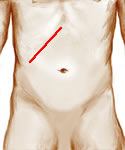
Incision for open (non-keyhole) surgery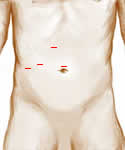
incisions for keyhole Surgery
Describe the stages of recovery and care plan.
Following laparoscopic cholecystectomy, you will stay in the hospital for one night and can return to normal activities in 7-10 days. If a larger incision is needed to remove the gallbladder, you will be required to stay for 4-5 days and can resume normal activities in 3-4 weeks.
Consult your surgeon on when you can start driving. Do not lift heavy objects in the first 2 weeks after surgery.
Visit your doctor immediately if you experience diarrhoea, fever, elevated heart rate, shortness of breath, swelling and pain in the legs, drainage of the wound or sudden stomach pain.
What are the outcomes of laparoscopic cholecystectomy?
The removal of the gallbladder by laparoscopic cholecystectomy ensures that no more stones form. Even without the gallbladder, your body can function well. There is no long term diet required.
What are the potential complications of laparoscopic cholecystectomy?
As with all surgeries, laparoscopic cholecystectomy may be associated with certain risks and complications such as infection, lung problems, blood clots in the leg or lungs, bile duct injuries, bile leakages and even death. These complications are greatly minimised when the surgery is performed by a skilled and highly experienced surgeon. Choose your surgeon carefully and make sure you ask everything you want to know before the surgery is performed.
How long will I be off work?
You will be able to resume work after 7–10 days if keyhole surgery is possible. For the open technique you will require 3–4 weeks off work.
How will my life change after laparoscopic cholecystectomy?
You will be able to lead a normal life after recovery from your laparoscopic cholecystectomy.
What is the cost of the procedure?
We will provide you with a full explanation of the costs of the operation to assist you in your decision to proceed. The costs will vary depending on your level of private health insurance.
How do I choose the best gallbladder surgeon for my operation? Why choose Mr Michael Bickford?
Mr Michael Bickford has a major interest in the management of gallstone disease. This practice offers all the procedural options that are required for complete management of gallstones and their possible complications, including ERCP. Mr Bickford was one of the first in Australia to perform keyhole surgery to remove the gallbladder and now has broad experience with more than 7000 operations performed.
Questions you should ask at consultation with your surgeon include:
How many of these operations have you performed? How many of these operations do you currently perform each week?
Have you ever damaged a bile duct during surgery? Do you routinely do an operative cholangiogram?
How often do you convert to the open technique?
What are the current research regarding laparoscopic cholecystectomy?
Ongoing research on laparoscopic cholecystectomy include:
- Li YP, Wang SN, Lee KT. Robotic versus conventional laparoscopic cholecystectomy: A comparative study of medical resource utilization and clinical outcomes. Kaohsiung J Med Sci. 2017 Apr;33(4):201-206.
- Tartaglia N, Cianci P, Di Lascia A, Fersini A, Ambrosi A, Neri V. Laparoscopic antegrade cholecystectomy: a standard procedure? Open Med (Wars). 2016 Nov 13;11(1):429-432.